Complete Roadmap: How to Get Your First IT Job in 2026 With No Experience — Step by Step
how to get your first IT job in 2026
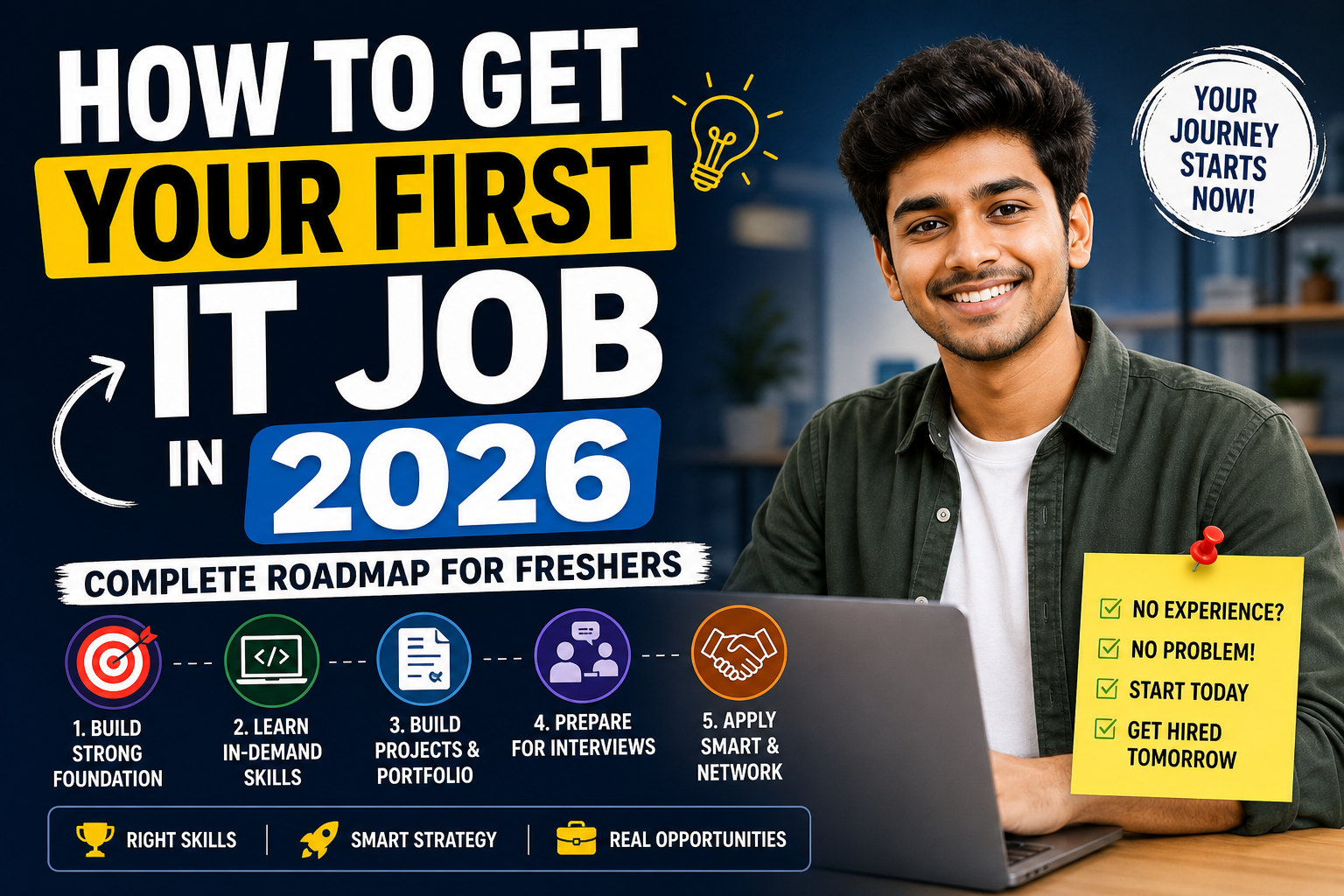
If you are wondering how to get your first IT job as a fresher in 2026 with no prior work experience, this is the most honest, most detailed answer you will find. Not “build skills and apply” — but the exact month-by-month actions, free resources, real platforms, and mindset shifts that Indian engineering freshers are using right now to land their first IT offer.
📑 What This Roadmap Covers
- The Honest Reality About Getting Your First IT Job in 2026
- Month 1 — The Skills Foundation You Cannot Skip
- Month 2 — Building Your Portfolio and Projects
- Month 3 — The Smart Application Strategy
- Month 4 — Interview Preparation That Actually Works
- Month 5–6 — How to Keep Going When It Gets Hard
- Best Platforms to Apply for IT Jobs in India 2026
- Free Courses to Learn Skills (Zero Cost, High Value)
- How to Handle Rejection Without Losing Momentum
- Frequently Asked Questions
🔍 The Honest Reality About How to Get Your First IT Job as a Fresher in 2026
Every year, lakhs of Indian engineering freshers graduate and ask the same question — how do I get my first IT job with no experience? The internet responds with vague advice: “learn coding,” “build projects,” “network on LinkedIn.” All true. All incomplete.
Here is what those guides won’t tell you: the average Indian IT fresher takes 3 to 8 months from graduation to first offer letter. This is normal. It is not a reflection of your intelligence or your worth. It is the reality of a market where supply of fresh graduates vastly exceeds the number of entry-level openings at any given moment — and where the freshers who succeed are not necessarily the most talented, but the most systematic.
The freshers who land their first IT job in 2026 the fastest share four traits:
- They build specific, demonstrable skills — not broad “I know a bit of everything” familiarity
- They create visible proof of those skills — GitHub repositories, deployed projects, certifications
- They apply with a strategy — not spray-and-pray to 200 companies but targeted applications with tailored resumes
- They treat rejection as data — they track what isn’t working and adjust, instead of either giving up or repeating the same approach
According to Economic Times IT hiring reports, India’s IT sector is projected to add over 3 lakh jobs in 2025–26, with a significant proportion targeting freshers through off-campus drives, AMCAT-linked hiring, and direct application portals. The jobs exist. The question is whether your preparation and strategy are good enough to reach them.
Month 1 is not about applying for jobs. It is about building the minimum viable technical foundation that makes you worth calling back when you do apply. The most common fresher mistake is skipping this phase and applying immediately — resulting in failed aptitude tests, blank technical interviews, and zero shortlists.
🎯 The 3-Track Decision: Which Path Are You On?
Before learning anything, decide your track. Trying to learn everything simultaneously is the fastest way to learn nothing deeply enough to impress anyone.
- Track A — Software Development: Java or Python → Spring Boot or Django → MySQL → REST APIs → Git. Target: TCS, Infosys, Wipro developer roles, product startups.
- Track B — Testing / QA: Java or Python basics → Selenium → Manual testing concepts → JIRA → SQL. Target: Accenture testing roles, HCL, Wipro QA positions.
- Track C — Cloud / DevOps (Emerging 2026 Path): Linux basics → AWS Cloud Practitioner → Docker intro → Git. Target: HCL, Tech Mahindra cloud roles, fast-growing mid-size IT companies.
- Choose your track (Track A / B / C)
- Set up your development environment
- Core language basics: syntax, loops, functions, arrays
- Start LeetCode Easy problems (5 per week)
- Create GitHub account — commit code daily
- OOPs concepts with code examples
- Database fundamentals — SQL queries, JOINs
- 10 more LeetCode Easy problems
- Revise: DBMS theory, OS basics, CN basics
- Set up LinkedIn profile (complete, not half-done)
⏱️ Daily Schedule That Actually Works
- Morning (2 hours): New concept learning — follow one structured course (see free courses section below)
- Afternoon (1.5 hours): Coding practice — LeetCode, HackerRank, or building a mini-feature
- Evening (30 minutes): Review what you learned, push code to GitHub, read one IT industry article
Month 2 is where you convert your Month 1 knowledge into visible, shareable proof of skills. This is the single most underutilised phase in the average Indian fresher’s job search — and it’s the phase that separates candidates who get interview calls from those who don’t.
Recruiters cannot verify that you “know Java” from a resume bullet. They CAN verify that you built a working Java application and pushed it to GitHub with proper documentation. That’s the difference between a claim and evidence.
🔑 The Two-Project Minimum Rule
You need at least two complete, deployed projects on GitHub before you start applying. Not two tutorial-follow-alongs — two projects where you made independent design decisions, hit real errors and debugged them, and can explain every line of code you wrote.
- Choose a project idea you actually find interesting
- Design the database schema first (even on paper)
- Build backend with proper folder structure
- Add user authentication (login/logout)
- Push to GitHub with a detailed README file
- Build a second, different type of project
- Deploy at least one project live (Render, Railway, or Vercel — all free)
- Write README with screenshots + setup instructions
- Record a 2-minute video demo (optional but impressive)
- Create or update your LinkedIn “Featured” section
💡 Project Ideas That Stand Out in 2026
- Track A — Dev: Job portal with search and filter, expense tracker with analytics dashboard, student management system with REST API, e-commerce backend with order tracking
- Track B — QA: Automated test suite for an existing public website (using Selenium), bug reporting tool with JIRA integration, test case management mini-application
- Track C — Cloud: Deploy a web app on AWS EC2 with auto-scaling, set up a CI/CD pipeline using GitHub Actions, create a serverless function with AWS Lambda and API Gateway
📝 Writing Your Resume Alongside Projects
Month 2 is also when you build your core resume — because your projects are your biggest asset and you should document them while the details are fresh. Follow the resume structure covered in our Silpa Careers Fresher Resume Guide and use each project as a rich, bullet-point-heavy section with measurable outcomes.
Month 3 is when you begin applying — but with a system, not a spray-and-pray approach. The single biggest mistake freshers make during this phase is applying to 100+ companies with one generic resume and then wondering why they never hear back.
🔢 The 10-10-10 Weekly Application Rule
Apply to exactly 30 positions per week, split across three tiers:
- 10 Tier-1 targets: Big IT companies (TCS, Infosys, Wipro, HCL, Accenture, Tech Mahindra) — through official career portals and off-campus drives. Lower hit rate but highest brand value if successful.
- 10 Tier-2 targets: Mid-size IT companies (Mphasis, Hexaware, Cognizant, LTIMindtree, Capgemini) — often faster hiring cycles and higher fresher-to-interview conversion rates.
- 10 Tier-3 targets: Startups, product companies, and local IT firms via LinkedIn, Unstop, and Internshala — best chance of getting real project experience that accelerates your career.
📋 Tailoring Each Application — The 15-Minute Rule
For every application, spend 15 minutes: read the job description carefully, adjust your resume summary to mention the specific role, reorder your skills to match the JD’s priority keywords, and personalise the first line of your cover email if one is required. This sounds like a lot — but 30 tailored applications a week convert far better than 100 copy-paste submissions.
📊 Track Everything in a Spreadsheet
Create a simple Google Sheet with columns: Company, Role, Date Applied, Platform Used, Resume Version, Status (Applied / Shortlisted / Rejected / Interview Scheduled), and Notes. This tracking system does three things: it prevents duplicate applications, it tells you which platforms are generating results, and it gives you psychological clarity — you can see your progress instead of feeling like you’re shouting into the void.
Month 4 is when applications start generating responses — and you need to be ready to convert shortlists into offers. Interview preparation runs parallel to applying from Month 3 onwards, but Month 4 is when you go deep on mock interviews and targeted technical revision.
🧠 Technical Interview Prep Plan
- OOPs (Week 13): Master all four pillars with code examples in your chosen language. Be able to explain abstract class vs interface, polymorphism types, and encapsulation — with live code if asked.
- DBMS + SQL (Week 13–14): Practice writing JOIN queries, subqueries, GROUP BY, and HAVING clauses from scratch. Revise normalization (1NF–3NF) with table examples. Understand ACID properties with the bank transfer example.
- OS + Networks (Week 14): Process vs Thread, Deadlock conditions, OSI model layers, TCP vs UDP — all with real analogies ready. Conceptual depth over memorised definitions.
- DSA Coding (Weeks 13–16 ongoing): 2 LeetCode problems daily — one Easy, one Medium. Focus on arrays, strings, hashmaps, linked lists, and trees. Time yourself to 25 minutes per problem.
- Write out “Tell me about yourself” (90 seconds)
- Prepare 3 specific “Why this company?” answers
- Practice “5-year plan” with honest ambition
- Prepare project deep-dive (every line explainable)
- Record mock HR interview on phone, watch back
- Do 2 technical mock interviews on Pramp (free)
- Practice with a friend or classmate weekly
- Join Discord/Telegram fresher groups for peer practice
- Review and note every question you struggled with
- Watch interview experience videos on YouTube
Month 5 and 6 are where the majority of freshers either break through or burn out. You have been applying for 2–3 months. You may have had rejections, near-misses, or deafening silence. This section is specifically about how to keep going — productively, not desperately.
🔄 The Month 5 Review — Diagnose Before You Double Down
Before blindly increasing application volume, run a diagnostic. Look at your tracking spreadsheet and answer these questions honestly:
- Are you getting shortlists? If less than 5% of applications are generating responses, the problem is your resume or your application targeting — fix these before applying more.
- Are you getting interview calls but failing at aptitude? The problem is test preparation — spend a week exclusively on timed aptitude practice (PrepInsta, IndiaBix).
- Are you reaching HR but not getting offers? The problem is communication and HR preparation — do 3 more mock HR interviews this week before your next real one.
- Are you getting technical interviews but failing them? The problem is technical depth — identify the specific topic where you struggled and spend one week going 3 layers deep on that topic.
📈 New Actions to Add in Month 5–6
- Attend virtual job fairs: Naukri, LinkedIn, and Unstop regularly host virtual hiring events — register for all of them. Direct recruiter contact at these events bypasses the ATS layer entirely.
- Referrals: Reach out to seniors, alumni from your college, or LinkedIn connections who work at target companies. A referred application at TCS, Infosys, or Wipro moves through screening 3x faster than a portal application. Message them professionally — one specific ask, not a vague “please help me get a job.”
- Third-party recruiters: Register on iMocha, AMCAT, and eLitmus — these are third-party assessment platforms that forward your profile to partner companies when you score well. Many Indian IT companies source freshers exclusively through these platforms.
- Add one new certification: An AWS Cloud Practitioner or Google IT Support certificate completed in Month 5 adds a new keyword to your resume and signals continued learning momentum to recruiters.
🌐 Best Platforms to Apply for Your First IT Job in India 2026
Knowing how to get your first IT job as a fresher in 2026 also means knowing exactly WHERE to apply — not just what to apply with. Different platforms serve different purposes, and using only one or two of them is leaving significant opportunities on the table.
Official Company Portals
Tier 1 TargetTCS iON NQT, Infosys InfyTQ/Instep, Wipro WILP careers.wipro.com, HCL Careers, Accenture ASE portal. Apply directly here — these bypass aggregators and go straight to the company’s ATS.
LinkedIn Jobs
Must Use DailySet up job alerts for “Software Engineer fresher Hyderabad” or your city. Turn on “Open to Work.” Connect with 5 new recruiters per week. LinkedIn referrals bypass ATS — worth 10x the effort of portal applications.
Naukri.com
Highest Volume IndiaIndia’s largest job portal — upload your resume and set it to “Active” so recruiters can find you. Apply to 5–10 freshers-specific roles daily. Update your resume on Naukri every 2 weeks to stay at the top of recruiter searches.
Unstop (formerly D2C)
Best for Campus & Off-CampusHosts off-campus drives, hackathons, and competitions directly tied to hiring pipelines at TCS, Deloitte, Amazon, and 500+ companies. Participating in contests here — even without winning — gets your profile noticed by company recruiters.
AMCAT & iMocha
Assessment-Based HiringGive the AMCAT test once and your score gets shared with 1000+ companies automatically. A good AMCAT score (70th+ percentile) generates inbound recruiter messages without any additional applications. myamcat.com — one-time investment, ongoing returns.
Internshala
Internships + Entry JobsIndia’s top internship platform also lists entry-level IT roles. An internship here converts to a full-time offer in many cases — and 3–6 months of internship experience dramatically improves your position in the job market. Never underestimate internship-to-job conversion.
📚 Free Courses to Learn Skills for Your First IT Job — 2026 India
One of the most important practical answers to how to get your first IT job as a fresher in 2026 is knowing which free resources are actually worth your time. Here is a curated, honest list — tested and recommended based on fresher community feedback:
| Skill | Free Resource | Platform | Duration | Best For |
|---|---|---|---|---|
| Java Full Course | Kunal Kushwaha — Java + DSA | YouTube | ~60 hrs | Track A (Dev) |
| Python Basics | CS50P — Intro to Python | Harvard / edX Free | ~10 hrs | All Tracks |
| Data Structures + Algorithms | Striver’s A2Z DSA Sheet | TakeUForward | Self-paced | All Tracks |
| SQL & DBMS | W3Schools SQL Tutorial | W3Schools + HackerRank SQL | ~8 hrs | All Tracks |
| AWS Cloud | AWS Cloud Practitioner Essentials | AWS Skill Builder (Free) | ~6 hrs | Track C |
| Web Development | The Odin Project — Foundations | theodinproject.com | ~120 hrs | Track A (Web) |
| Software Testing | NPTEL Software Testing (IIT Kharagpur) | NPTEL / Swayam | 12 weeks | Track B (QA) |
| Git & GitHub | Git and GitHub for Beginners | freeCodeCamp YouTube | ~2 hrs | All Tracks |
| Aptitude Prep | PrepInsta Company-Specific Tests | prepinsta.com | Ongoing | All — Aptitude Round |
| Communication Skills | English for Career Development | Coursera — U.Penn (Audit Free) | ~4 weeks | All — HR Round |
💪 How to Handle Rejection and Keep Going — Fresher Job Search 2026
No guide on how to get your first IT job as a fresher in 2026 is honest if it pretends rejection won’t be part of the journey. It will. Repeatedly. Here’s the psychological and practical framework for handling it without losing momentum:
Mindset Reset: Rejection Is Information, Not Verdict
Every rejection tells you something specific if you examine it honestly. Rejected at the aptitude round? Your test prep is weak. Rejected after the technical interview? Your conceptual depth or communication needs work. Rejected after HR? Your narrative or confidence needs refinement. A rejection is not “you are not good enough” — it is “this specific thing needs improvement.” Treat every rejection as a free diagnostic report and use it accordingly.
Action Protocol: What to Do Immediately After a Rejection
Within 24 hours: update your tracking spreadsheet with what round you reached and what you think went wrong. Within 48 hours: identify ONE specific thing to fix — just one. Within one week: address that specific weakness before your next interview. This protocol prevents the twin traps of either ignoring lessons from rejection or spiralling into unfocused overthinking.
System Defence: Protect Your Progress During Rejection Streaks
When rejections cluster together — three in a week, five in a month — the instinct is to either apply more frantically or stop applying entirely. Both are wrong. Instead: maintain your daily schedule exactly, talk to one person who has been through this (college senior, online community), and explicitly remind yourself that the average fresher takes 4–7 months. You are likely on track even when it doesn’t feel like it.
Community: Find Your People — It Changes Everything
The loneliness of a solo job search amplifies every rejection 3x. Join fresher communities on LinkedIn, Discord, and Telegram where people share daily updates, interview experiences, and job leads. Communities like “Off Campus Placements,” “Fresher Jobs India,” and “Placement Season” on LinkedIn have hundreds of thousands of members in exactly your situation. Being around people who are going through the same thing — and succeeding — is one of the most powerful motivational resources available to you.
✅ The Complete 6-Month Checklist — First IT Job Roadmap 2026
Month 1: Skills chosen, daily learning routine established, 20+ LeetCode Easy problems solved, GitHub active with daily commits
Your track is decided. Your environment is set up. You are learning consistently every day.
Month 2: 2 complete GitHub projects with README, 1 project deployed live, 1-page resume ready, LinkedIn profile complete and active
You now have visible, shareable proof of your technical skills that a recruiter can check in 30 seconds.
Month 3: Applying 30 jobs/week across 3 tiers, tracking all applications in a spreadsheet, tailoring each resume to JD
Your applications are systematic, tracked, and targeted — not random.
Month 4: OOPs, DBMS, OS, Networks revised in depth; 2+ mock technical interviews completed; HR answer scripts prepared and practiced aloud
You are ready to convert a shortlist into an offer — not just to reach the interview.
Month 5: Application strategy reviewed and adjusted based on data; referral outreach started; AMCAT or eLitmus taken; new certification added
You are not repeating Month 3 with more volume — you are improving the quality and reach of your search.
Month 6: Offer received OR clear diagnosis of what needs to change + renewed plan; no giving up; community support active
By month 6, most systematic freshers have at least one offer — and the ones who don’t have a clear reason why and a concrete plan to address it.
🚀 Start Applying Today — Fresh IT Drives on Silpa Careers
New off-campus drives, IT job alerts, and fresher opportunities added every single day — curated for 2024, 2025 & 2026 batch graduates.
TCS NQT 2026 → Infosys 2026 → Accenture ASE → HCL Freshers → Tech Mahindra →