10 High-Paying Skills Every Fresher Must Learn in 2026 to Get Hired Fast
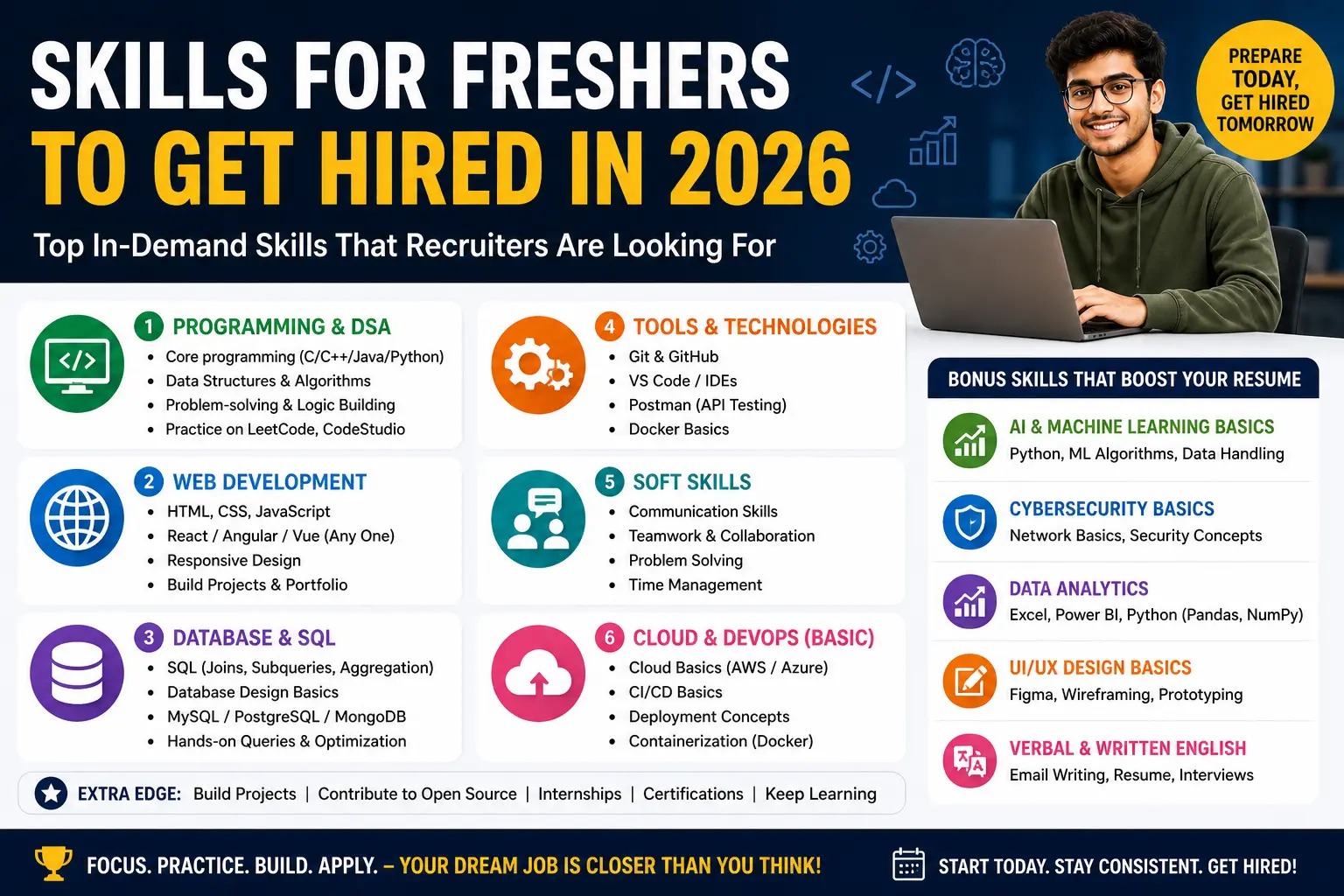
The right skills for freshers to get hired in 2026 are not what most college syllabuses are teaching. This guide breaks down the 10 skills that Indian IT recruiters are actively paying premiums for — with why each matters, exactly how long it takes to learn, the best free resources, and which companies specifically look for them.
📑 10 Skills Covered in This Guide
🔍 Why the Right Skills for Freshers in 2026 Are Different From Before
The Indian IT job market in 2026 is hiring for a fundamentally different skill profile than it was in 2020. The era of “learn Java basics, pass the NQT, get placed at TCS” still exists — but the freshers who are getting premium packages, faster placements, and better project assignments are those who have built skills that sit at the intersection of what’s immediately usable on the job and difficult for untrained candidates to fake.
According to the NASSCOM IT-BPM sector report, cloud computing, AI/ML, data analytics, and automation are the four fastest-growing skill demands in Indian IT hiring for 2025–26. Simultaneously, foundational skills like SQL, communication, and problem-solving remain non-negotiable filters at every single company, regardless of specialisation.
This guide covers all 10 skills that matter — from the foundational to the emerging — with one clear principle: every skill listed here has a direct, traceable impact on whether you get shortlisted, offered, or promoted faster.
Python is the most versatile programming language in the world in 2026 — used for web development (Django, Flask), data analysis (Pandas, NumPy), machine learning (TensorFlow, scikit-learn), automation scripting, and API development. A fresher with solid Python skills can contribute to a live project from Week 1 of joining — which is exactly why recruiters across service companies, product companies, and startups rank Python as their top requested fresher skill. It is also the language used in 8 of the 10 most popular data and AI frameworks — meaning every adjacent skill you learn builds on Python.
SQL is the language of data — and every company, in every industry, runs on data stored in relational databases. A fresher who can write clean SQL queries, understand JOINs, design normalised schemas, and optimise slow queries is immediately productive on any project. SQL is also consistently the highest-scoring section for freshers in technical interviews at TCS, Infosys, and Wipro — because most candidates know the theory but have never actually written queries from scratch. That gap is where you can stand out with 4 weeks of dedicated practice.
Cloud computing is not the future of IT — it is the present. In 2026, over 85% of enterprise IT workloads in India run on cloud infrastructure from AWS, Microsoft Azure, or Google Cloud Platform. Every large IT company — TCS, Infosys, Wipro, HCL, Tech Mahindra — has dedicated cloud practices and actively recruits freshers with even foundational cloud knowledge. The AWS Cloud Practitioner certification alone has been reported to increase fresher interview shortlisting rates by 40–60% at cloud-focused roles, because it signals verified knowledge rather than just a resume claim.
Artificial Intelligence and Machine Learning have moved from buzzword to business requirement in 2026. Every major IT company — TCS, Infosys (through its AI division), Wipro, and HCL — now has dedicated AI/ML practices serving global clients. Importantly, companies are not just looking for PhD-level ML researchers — they are actively hiring freshers who understand the fundamentals: what supervised vs unsupervised learning means, how to train a basic classification model, how to work with datasets using Python. This foundational AI/ML knowledge, combined with Python proficiency, puts you in a distinctly smaller and more valuable applicant pool than general software engineering candidates.
Data analysis is one of the most cross-functional skills a fresher can develop in 2026 — it applies to IT roles, business analyst positions, consulting, product management, and operations roles simultaneously. A fresher who can take a raw CSV, clean it with Pandas, analyse it with NumPy, and visualise insights with Matplotlib or Seaborn is immediately contributing business value. This skill combination (Python + SQL + data visualisation) is the entry point to the data analyst career track — one of the most actively hiring fresher categories at both IT companies and non-IT organisations like banks, e-commerce platforms, and healthcare companies.
Every fresher who has ever listed “MS Office” on their resume without being able to write a VLOOKUP formula has been caught in an interview. Advanced Excel — VLOOKUP/XLOOKUP, pivot tables, conditional formatting, INDEX-MATCH, basic macros, and data validation — is actively tested in Business Analyst, Operations, and Project Management fresher roles at Accenture, Deloitte, Cognizant, and virtually every BFSI company. It is the fastest skill to learn on this entire list and provides the highest immediate ROI for non-developer fresher roles. Many candidates who target software roles overlook this and lose BA/PM opportunities they would have easily won.
Communication skills are listed last on most fresher priority lists and eliminated most candidates first in actual hiring. In 2026, with global delivery models meaning Indian freshers regularly communicate with US, UK, and European clients from Day 1, the ability to express technical ideas clearly — in English, in writing and verbally — is a non-negotiable hiring criterion at every IT company above the trainee grade. Poor communication eliminates technically strong candidates in HR rounds, in client interaction tests, and in group discussion rounds. Strong communication amplifies your technical value by making your ideas legible to managers, clients, and teammates — the people who influence your growth and appraisal.
Git is how every professional software team in the world manages code — period. A fresher who doesn’t know Git cannot contribute to a team project without causing chaos. Beyond the functional necessity, an active GitHub profile with regular commits is one of the most powerful resume signals you can send — it shows you write code consistently, understand collaborative development, and have real projects to show. Many technical interviewers now check GitHub profiles before the interview begins. A blank or one-repository GitHub signals a fresher who only coded for assignments. A profile with 5+ repositories, regular commits, and clean READMEs signals a genuine developer.
Java remains the primary language for enterprise application development at India’s Big 4 IT companies — and for good reason. Spring Boot (Java) powers the majority of enterprise backend systems built by TCS, Infosys, and Wipro for their BFSI, healthcare, and retail clients. More immediately, OOPs concepts in Java are the #1 most asked category in technical interviews at all three companies. A fresher with strong Java fundamentals — OOPs, Collections, Exception Handling, basic multithreading — and a Spring Boot project has a significantly higher shortlisting rate at service IT companies than a Python-only candidate applying for the same role.
Data Structures and Algorithms is the gateway skill that determines whether your resume becomes an interview call — or a rejection email — at companies that run coding assessments. For service companies (TCS NQT, Infosys InfyTQ, Wipro WNTT), 50–60 Easy LeetCode problems and pattern recognition across arrays, strings, and hashmaps is sufficient. For product companies and startups, Medium to Hard problems on trees, graphs, dynamic programming, and greedy algorithms are regularly tested. DSA is the one skill where consistent daily practice creates a compound learning effect — each problem you solve makes the next 3 problems easier to approach. Start early, practice daily, and never stop while you’re job hunting.
📊 All 10 Skills at a Glance — Fresher Priority Guide 2026
| # | Skill | Learn Time | Difficulty | Salary Impact | Priority |
|---|---|---|---|---|---|
| 1 | Python Programming | 6–10 weeks | Easy | ₹6–14 LPA | 🔥 Very High |
| 2 | SQL & DBMS | 4–6 weeks | Easy | +20–35% salary | 🔥 Very High |
| 3 | Cloud (AWS/Azure) | 4–6 weeks | Medium | ₹8–18 LPA | 🔥 Very High |
| 4 | AI / ML Basics | 8–12 weeks | Medium | ₹7–16 LPA | ⭐ High |
| 5 | Data Analysis | 6–8 weeks | Medium | ₹4.5–8 LPA | ⭐ High |
| 6 | Excel / Sheets | 3–4 weeks | Easy | BA / Ops roles | ⭐ High |
| 7 | Communication | 3–6 months | Ongoing | +15–30% appraisal | 🔥 Very High |
| 8 | Git & GitHub | 2 weeks | Easy | Profile credibility | 🔥 Must Have |
| 9 | Java + OOPs | 8–12 weeks | Medium | ₹3.5–15 LPA | 🔥 Very High |
| 10 | DSA / Problem Solving | 6 wks–6 months | Hard | 2× salary tracks | 🔥 Essential |
🚀 Start Building Skills AND Apply — Jobs Are Open Right Now
Don’t wait until you’ve “learned everything” to apply. Start applying from Month 2. Here are the freshest drives on Silpa Careers:
TCS NQT 2026 → Infosys 2026 → Accenture ASE → HCL Freshers → Tech Mahindra →