Why 80% of Freshers Fail Job Interviews in 2026 — And Exactly How to Improve Your Chances
Every year, thousands of freshers apply for jobs but only a small percentage consistently receive interview calls and offers. The difference is usually not luck — it often comes down to preparation, communication, projects, and understanding what employers actually expect. In this guide, we break down the most common reasons candidates struggle and practical ways to improve before your next interview.
📑 What This Article Covers
Why Many Freshers Struggle in Job Interviews — and What Usually Makes the Difference
Every year, thousands of freshers apply for roles across IT services, startups, support operations, and graduate hiring programs. Many candidates put in effort but still feel frustrated when applications do not turn into interview calls or job offers.
In many cases, the gap is not only technical knowledge. Recruiters often evaluate communication, clarity of thought, project understanding, preparation habits, consistency, and whether a candidate understands the role they applied for. Academic performance matters, but it is rarely the only deciding factor.
This guide focuses on practical interview patterns that freshers commonly experience and realistic ways to improve. Instead of generic motivation, we’ll look at common mistakes, preparation habits, and changes that can help candidates approach interviews with more confidence and structure.
Use this article as a preparation guide rather than a prediction of results. Every interview process is different, but improving preparation, communication, and role awareness can improve readiness over time.
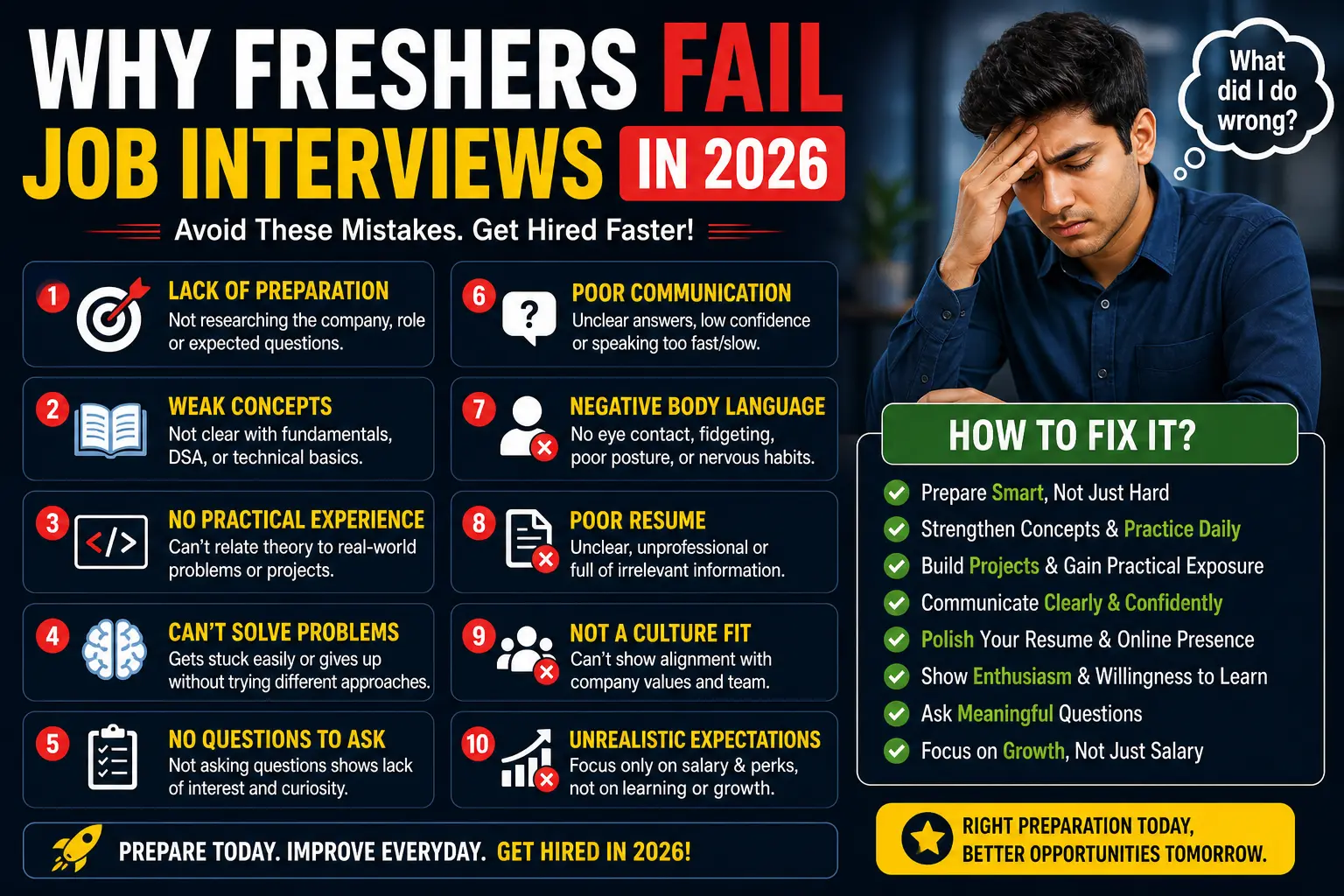
🚫 10 Common Reasons Freshers Struggle in Job Interviews — and Practical Ways to Improve
The examples below focus on common interview patterns candidates experience. The goal is not to predict outcomes, but to identify habits that can make preparation more effective over time.
Many freshers spend time collecting notes, watching videos, and memorising definitions. This helps for recall, but interviews often include follow-up questions designed to test understanding and application.
For example, a candidate may explain a concept correctly but struggle to apply it in a simple scenario, compare alternatives, or describe where it would be used in a project.
Imagine a candidate explaining object-oriented programming confidently but finding it difficult to build a short example or explain why one approach was chosen over another. Interviewers may interpret this as incomplete understanding rather than lack of intelligence.
Use a simple three-step approach:
- Explain the concept in your own words
- Create a small example or mini project
- Describe one real situation where the concept is useful
Studying fewer topics with deeper understanding is often more effective than trying to memorise everything before an interview.
Many freshers try to make their resume look stronger by adding multiple technologies, certifications, and tools. During interviews, recruiters often ask follow-up questions to understand whether those skills were used in projects, coursework, internships, or practical work.
If a candidate struggles to explain something written on their own resume, the discussion can become harder—even if they perform well in other areas.
Imagine a candidate adding machine learning after completing a short course. During the interview, they are asked to explain a basic concept or describe where they applied it. They struggle—not because they lack ability, but because they included the skill before becoming comfortable discussing it.
Before keeping a skill on your resume, ask:
- Can I explain the concept simply?
- Can I describe where I used it?
- Can I answer at least two follow-up questions?
- Can I show a small project or example?
A focused resume with skills you can discuss confidently is often more effective than a longer list that creates unnecessary pressure during interviews.
Project discussions are a common part of fresher interviews because they help recruiters understand how candidates think, solve problems, and make decisions.
Many candidates describe their project at a high level but struggle when interviewers ask follow-up questions about architecture, technology choices, challenges, or improvements.
Imagine a candidate presenting a Hospital Management System project confidently but finding it difficult to explain why one database was chosen over another or what trade-offs were considered. The challenge is often not technical ability—it is preparation and reflection on decisions made during development.
Prepare answers to these project questions before interviews:
- Why did you choose this technology?
- What challenge took the most time to solve?
- What would you improve if you rebuilt it?
- What was your personal contribution?
- How would the system change with more users?
Your project is often one of the few topics where you already have context and experience. Spending time preparing project explanations can make interviews feel more structured and confident.
One challenge many freshers face is assuming they must know every answer immediately. When an unexpected technical question appears, candidates sometimes become silent or respond only with “I don’t know.”
Interviewers are often trying to understand how candidates think, communicate, and approach unfamiliar situations—not only whether they already know the exact answer.
Imagine being asked about a concept you have not studied in detail. Instead of ending the discussion immediately, you explain what related concept you know and attempt to reason through the problem. Even if the answer is incomplete, structured thinking can create a better discussion.
Try this approach:
- Be honest if you do not know the exact answer
- Connect it to a concept you understand
- Explain your reasoning clearly
- Ask if your direction makes sense
Example: “I haven’t studied this topic in detail yet, but based on what I know about a related concept, my current understanding would be…”
This approach shows communication, curiosity, and problem-solving habits while keeping the conversation moving.
Some freshers prepare technical topics carefully but find interviews difficult because their ideas become difficult to follow under pressure. This may appear as rushed speaking, very short answers, excessive filler words, or difficulty structuring thoughts clearly.
Interview communication is usually not about speaking perfect English—it is about expressing ideas clearly enough for recruiters and interviewers to understand your thinking.
Imagine a candidate who understands coding concepts well but gives a long and unstructured answer to a simple introduction question. The interviewer may struggle to identify the candidate’s strengths even though the technical ability exists.
Try a simple weekly communication routine:
- Record a 60–90 second self-introduction
- Listen for repeated filler words
- Practice answering one common interview question daily
- Read short articles aloud for clarity and pacing
The goal is not perfect communication. The goal is becoming clearer, calmer, and more structured each time you practise.
Many freshers apply to a large number of openings using the same resume and approach for every role. While broad applications can sometimes help, candidates may improve their chances when they understand the role, adjust their resume where appropriate, and prepare before interviews.
Recruiters often look for signs that candidates understand the position, the required skills, and why they are interested in the opportunity.
Imagine two candidates with similar backgrounds. One applies quickly to many openings without reviewing job requirements. Another spends a little extra time understanding the role, updating project descriptions, and preparing company-specific answers. The second candidate may feel more prepared during later interview stages.
Before applying:
- Read the job description carefully
- Highlight relevant projects and skills
- Prepare a short answer for “Why this role?”
- Track applications in a spreadsheet
- Review common interview topics before interviews
Applying consistently while staying organised can make preparation easier and reduce unnecessary repetition.
Many freshers spend time learning courses, tutorials, and certifications but never turn that learning into something visible. Recruiters and interviewers often find it easier to understand skills when candidates can discuss projects, assignments, portfolios, or practical examples.
A portfolio does not need to be large—it can be a small project, internship work, GitHub repository, case study, design sample, or documented learning journey.
Imagine two candidates describing similar technical skills. One talks only about topics studied. The other explains a small project they built, what challenges they faced, and what they learned. Practical examples often make conversations more concrete and memorable.
Build simple evidence of your work:
- Upload one project with clear documentation
- Write a short project summary
- Add portfolio links where relevant
- Keep examples updated over time
- Be ready to explain your contribution
The goal is not to create a perfect portfolio—it is to make your learning easier to demonstrate during interviews.
Job searching can feel discouraging, especially for freshers applying for the first time. One common pattern is treating each rejection as proof that something is fundamentally wrong rather than treating it as information that can guide preparation.
Interviews often test different combinations of communication, technical understanding, role fit, timing, and preparation. One result does not always reflect overall ability.
Imagine a candidate noticing that similar questions repeatedly appear across interviews—project explanations, resume discussions, communication rounds, or technical basics. Instead of moving on immediately, they document patterns and prepare more intentionally for future opportunities.
After each interview, create a short review:
- Questions that felt difficult
- Topics to revise
- Questions answered confidently
- Things to improve next time
- Actions to complete before the next interview
Over time, these notes can become a useful preparation record and help make future interviews feel more familiar and structured.
Many freshers spend time preparing technical questions but spend very little time understanding the company, role, or team they applied for. During HR or introductory rounds, this can make answers feel generic and disconnected from the opportunity.
Interviewers often use questions like “Why this company?” to understand preparation, interest, and whether the candidate understands the role expectations.
Imagine two candidates applying for the same position. One gives a general answer focused only on growth and learning. Another briefly mentions a product, initiative, technology area, or business focus that connects with their interests. The second answer may feel more prepared and specific.
Before interviews, spend a few minutes researching:
- Company products or services
- The role description
- Recent updates or initiatives
- Technology or business areas
- How your interests connect to the opportunity
The goal is not to memorise company facts—it is to give more relevant and thoughtful answers during conversations.
Many freshers delay applications because they want to finish one more course, improve one more project, or make their resume feel perfect first. Preparation is valuable, but delaying applications for too long can reduce opportunities to gain real interview experience.
Interviews often reveal strengths and gaps that are difficult to notice through preparation alone.
Imagine two candidates with similar preparation levels. One waits until everything feels complete before applying. The other starts applying while continuing to learn and improve. Over time, the second candidate may gain more familiarity with interview formats, questions, and communication expectations.
Consider starting applications once you have:
- One project you can explain confidently
- Basic understanding of core concepts
- A resume you feel comfortable discussing
- A short self-introduction prepared
You do not need to know everything before applying. Balancing preparation with real interview exposure can make future interviews feel more manageable and productive.
🧠 A More Useful Way to Think About Interview Preparation
Understanding common interview mistakes is helpful, but long-term improvement usually comes from changing preparation habits rather than searching for perfect answers.
Candidates often have similar starting points but approach preparation differently. Small differences in consistency, reflection, and application habits can become noticeable over time.
- Waiting to feel completely ready
- Treating rejection as final feedback
- Collecting courses without practice
- Applying without reviewing the role
- Keeping the same resume for every application
- Preparing only technical questions
- Avoiding mock interviews
- Ignoring project explanations
- Apply while continuing to improve
- Review interviews and identify patterns
- Turn learning into small projects
- Understand the role before applying
- Update resume based on relevance
- Prepare communication alongside technical topics
- Practise interviews regularly
- Keep examples of real work ready
One Small Shift That Makes Preparation Easier
Instead of asking “Am I ready yet?”, try asking “What is the next improvement I can make?”
This shift encourages continuous progress instead of waiting for perfect preparation. Interviews become easier to learn from when they are treated as part of the process rather than a final judgement.
📅 A Practical 30-Day Interview Preparation Plan
This plan is designed to help freshers build preparation habits gradually. Adjust the schedule based on your college, work, or personal commitments. Consistency matters more than perfection.
Week 1 — Resume & Project Review
Build a stronger foundation before adding new topics
- Day 1: Review resume and update project descriptions
- Day 2: Prepare project explanations and contributions
- Day 3–4: Revise one core technical subject
- Day 5–6: Practice coding or problem solving
- Day 7: Record and review self-introduction
Week 2 — Technical Preparation & Applications
Continue learning while beginning applications
- Day 8–9: Revise weak technical areas
- Day 10–11: Solve practice questions
- Day 12: Research target roles and companies
- Day 13–14: Submit a small batch of applications
Week 3 — Mock Interviews & Communication
Improve clarity and interview familiarity
- Day 15–16: Complete one mock interview
- Day 17: Prepare common HR questions
- Day 18–19: Practise explaining technical topics aloud
- Day 20–21: Review progress and adjust preparation
Week 4 — Improve and Repeat
Keep applying and refine weak areas
- Day 22–24: Continue applications thoughtfully
- Day 25–26: Add one project or portfolio update
- Day 27–28: Review application patterns
- Day 29–30: Set goals for the next month
What Progress Might Look Like After 30 Days
By the end of the month, aim to have a clearer resume, better project explanations, regular practice habits, a few applications submitted, and more confidence discussing your work.
🌟 Practical Habits That Can Make Interview Preparation More Effective
Candidates improve at different speeds, but certain preparation habits appear consistently among people who become more confident and organised over time.
Start Before Everything Feels Perfect
Many candidates continue learning while also applying and gaining interview exposure. Real conversations often reveal areas to improve that are difficult to notice during preparation alone.
Track Progress and Patterns
Keeping notes about applications, interviews, and preparation topics can help identify what is working and what needs more attention.
Develop Communication Alongside Technical Skills
Explaining projects, answering clearly, and discussing ideas calmly are skills that improve with practice.
Create Examples of Your Work
Projects, portfolios, assignments, blogs, and documented learning can help make experience easier to discuss.
Reflect Instead of Starting Over
Not every interview leads to an offer. Reviewing what happened and making small improvements can create progress over time.
Think Long-Term About Career Growth
Early roles often provide experience, teamwork exposure, and practical learning that can support future opportunities.
🚀 Continue Your Career Preparation
If this guide helped you identify areas to improve, continue with practical resources including fresher opportunities, interview preparation, and career guides designed for recent graduates.
Choose the topics most relevant to your current stage instead of applying everywhere at once.
Latest Fresher Jobs →Interview Preparation →Career Guides →Internships →❓ Frequently Asked Questions
🔗 Continue Reading
If you found this guide useful, continue with related topics based on where you are in your preparation journey.