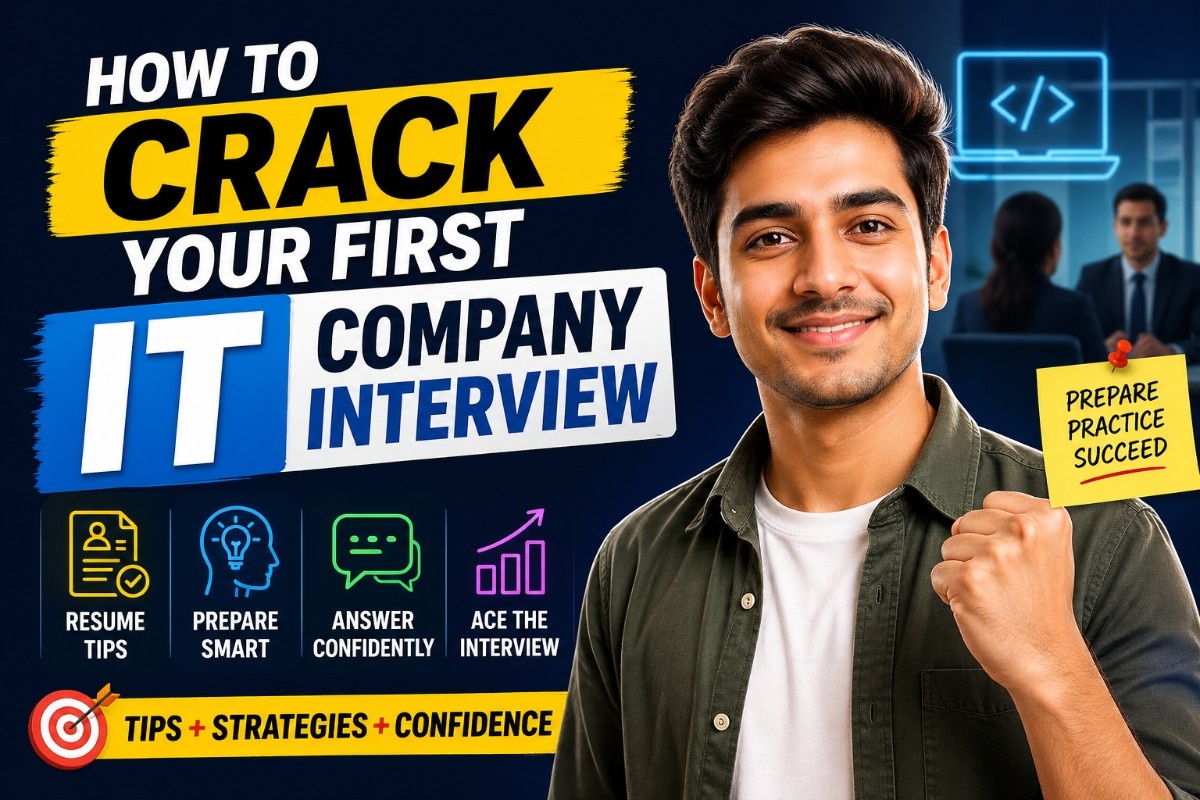
How to Crack Your First IT Company Interview in 2026 — The Ultimate Guide for Freshers
You’ve been sending applications everywhere. You get a shortlist email and suddenly your heart races — “Now what do I even prepare?” This guide is your step-by-step answer. No fluff, no copy-paste theory. Real advice that actually works in 2026 IT hiring.
📑 What You’ll Learn in This Guide
- The Honest Reality of IT Fresher Interviews in 2026
- The Right Mindset Before You Start Preparing
- Understanding Every Interview Round (and What Really Happens)
- How to Prepare Technical Rounds Without Burning Out
- Coding Round Strategy — What to Practice and What to Skip
- Cracking the HR Round — The Round Most Freshers Underestimate
- Your Resume Is Either Helping or Hurting You
- The 4-Week Preparation Plan That Actually Works
- 7 Mistakes Freshers Make That Kill Their Chances
- Frequently Asked Questions
🔍The Honest Reality of IT Fresher Interviews in 2026
Let’s start with something most career blogs won’t tell you: IT fresher hiring in 2026 is both easier and harder than it was in 2022. Easier because companies are hiring again in bulk after the 2023–24 slowdown. Harder because AI tools have flooded the internet with “preparation content” — so every candidate looks similar on paper.
The freshers who are getting placed in companies like TCS, Infosys, Wipro, Accenture, HCL, and Tech Mahindra are not necessarily the ones with the highest CGPA. They are the ones who:
- Understand exactly what each round tests (not just what to study)
- Practice with intent rather than just ticking checkboxes
- Can explain even basic concepts clearly and confidently
- Show up to the interview as a person, not just a profile
📊 A Real Stat Worth Knowing
Industry estimates suggest that in mass IT hiring drives, roughly 60–70% of candidates who clear the aptitude round fail at the technical or HR round — not because they didn’t know the answers, but because they couldn’t communicate them well. Preparation without communication practice is only half the work.
The IT industry in 2026 is also evolving fast. Companies now expect freshers to have at least surface-level awareness of AI tools, cloud platforms, and agile workflows — even at the entry level. You don’t need to be an expert, but you must not sound completely unaware either.
🧠The Right Mindset Before You Start Preparing
Before you open GeeksForGeeks or LeetCode, there are three mindset shifts that will make everything else more effective. Most freshers skip this and wonder why their preparation doesn’t convert into results.
Mindset Shift #1 — Stop Trying to Know Everything
The #1 mistake freshers make is trying to prepare every topic from every subject before the interview. You spend 3 weeks on Operating Systems, 2 weeks on DBMS, and suddenly you’re out of time and everything feels blurry. Instead, go deep on fewer topics rather than shallow on everything. Interviewers ask follow-up questions. If you say you know something, be ready to go 3 layers deep on it.
Mindset Shift #2 — Every Rejection Is Data, Not Failure
If you attend 10 interviews before getting placed, that’s not unusual — it’s actually the industry average for freshers. Each rejection tells you something: maybe your resume isn’t strong enough, maybe your coding speed is slow, maybe your communication needs work. Treat each interview as a paid lesson (you’re learning for free, actually).
Mindset Shift #3 — Companies Are Not Doing You a Favour
Shift your thinking from “please select me” to “let me show you what I bring to the table.” This changes your body language, your confidence in answers, and how you handle pressure questions. Interviewers notice the difference immediately.
🗺️Understanding Every Interview Round (and What Really Happens)
Most IT companies follow a 3–4 round structure for freshers. But understanding what each round is actually evaluating — beyond the surface level — changes how you prepare for it.
| Round | What They Say It Tests | What It ACTUALLY Tests | Failure Reason |
|---|---|---|---|
| Aptitude / AMCAT / WNTT | Logical, verbal, quant skills | Can you think under time pressure? | Poor time management in the test |
| Coding Round | Programming ability | Problem-solving approach + clean code habit | Trying to solve perfectly instead of partially |
| Technical Interview | CS fundamentals knowledge | How deep do you understand — can you explain simply? | Memorized answers without understanding |
| HR Round | Culture fit, communication | Will you stay? Can we work with you daily? | Vague or scripted answers that feel fake |
Notice that nearly every round has a hidden evaluation criterion that most candidates don’t prepare for. Knowing this, you can prepare smarter — not just harder.
💡How to Prepare Technical Rounds Without Burning Out
Technical rounds for IT freshers in 2026 typically focus on four core areas. Here’s how to approach each one without spending months on a single subject:
1. Data Structures & Algorithms (DSA) — The Unavoidable One
DSA is non-negotiable for almost every IT company coding round. But here’s what freshers get wrong: they try to solve 300+ LeetCode problems before the interview. You don’t need quantity — you need conceptual clarity on 8–10 core patterns.
- Arrays & Strings — sliding window, two pointers, frequency count
- Linked Lists — reversal, cycle detection, merge operations
- Stack & Queue — bracket matching, next greater element
- Trees — BFS, DFS, lowest common ancestor
- Sorting & Searching — bubble, merge, binary search variations
- Hashing — HashMap use cases, collision handling concept
2. Object-Oriented Programming (OOPs) — Fresher Favourite Topic
Every IT fresher interview — from TCS to Infosys to Wipro — asks OOPs questions. The good news is that the same 5–6 concepts come up again and again. The bad news is that most freshers memorize definitions without understanding real examples.
What to focus on: Inheritance with real examples, Polymorphism (compile-time vs run-time with code), Encapsulation (why it matters in real systems), Abstraction (abstract class vs interface — this is asked 90% of the time).
3. DBMS & SQL — Underestimated but High Scoring
SQL questions in technical interviews are often the easiest way to score points — because most candidates don’t prepare them well. Focus on: JOINs (inner, left, right, full), GROUP BY with HAVING, subqueries, normalization (1NF to 3NF), and transaction concepts (ACID properties).
Practice writing SQL queries by hand — not just reading them. If you can write a JOIN query with a GROUP BY and a subquery without looking anything up, you’ll handle any fresher-level SQL question comfortably.
4. Operating Systems & Computer Networks — Conceptual Only
For most fresher roles in service companies like TCS, Wipro, Infosys, you don’t need OS and CN to be your strongest topic. You need enough to answer 3–4 basic questions confidently. Focus on: Process vs Thread, Deadlock conditions, Paging vs Segmentation, OSI Model layers, TCP vs UDP, and HTTP vs HTTPS.
⌨️Coding Round Strategy — What to Practice and What to Skip
The coding round is where the most anxiety lives for freshers — and also where the most unnecessary anxiety lives. Here’s a reality check: for Tier-2 and Tier-3 IT companies (service sector), coding rounds are rarely harder than Easy-Medium LeetCode. For product companies and startups, the bar is higher.
The “Partial Solve” Strategy — Your Secret Weapon
Most freshers think they need to fully solve every coding problem to pass. That’s wrong. In many platforms like HackerRank and CoCubes, partial test case passes still earn you points. If you can’t solve the full problem, solve it for basic cases, explain your logic in comments, and show your approach. A partially solved problem with clean code and good comments often beats a hacked-together full solution.
What to Practice on LeetCode/HackerRank
- Solve at least 40–50 Easy problems across arrays, strings, and hashmaps first
- Then do 20–25 Medium problems on trees, sliding window, and two pointers
- For service companies: Easy + some Medium is enough
- Always time yourself — code the solution in 20–25 minutes maximum
- After each problem: rewrite from scratch without looking, then check complexity
Platforms to Use (Not All Are Equal)
- LeetCode — Best for concept building and quality problems
- HackerRank — Best for company-specific practice (matches actual test UX)
- PrepInsta / Unstop — Best for practicing company-specific test patterns (TCS iON, AMCAT, eLitmus)
- GeeksForGeeks — Best for theory + interview question bank
🤝Cracking the HR Round — The Round Most Freshers Underestimate
Freshers often celebrate after passing the technical round thinking “the hard part is over.” The truth is: a surprising number of candidates fail at HR — especially in large company drives where interviewers are specifically checking for red flags around attitude, commitment, and communication.
Questions You Will Almost Certainly Face (With Better Answers)
“Tell me about yourself.”
Don’t recite your resume. Use this structure: who you are academically → one project or achievement that shows what you can do → why you’re excited about this specific company. Keep it under 90 seconds and practice it until it sounds natural, not rehearsed.
“Why do you want to join [Company Name]?”
The worst answer: “It is a good company and I want to grow my career.” The better answer: Mention something specific — their training program, their clients, a technology they work with, or a value of theirs that resonates with you. Research 10 minutes before the interview and it shows.
“Where do you see yourself in 5 years?”
Companies are checking for realistic ambition and retention likelihood. A good answer: “I see myself growing into a senior technical role, contributing to larger client projects. I’m especially interested in developing expertise in [specific tech area related to the company’s work]. I want to build that foundation here.” Sounds genuine. Shows direction. Doesn’t sound like you’ll leave in 6 months.
“Do you have any questions for us?”
Always say yes. Ask about the onboarding process, the team structure you’d be joining, or what a typical first 3 months look like. This shows genuine interest. Never say “No, I’m good” — it signals disengagement.
📄Your Resume Is Either Helping or Hurting You
Your resume is the first filter. Before you even get to an interview, a recruiter spends 7–10 seconds on your resume to decide if you’re worth calling. Most fresher resumes don’t pass this test — not because the candidates aren’t good, but because the resume doesn’t communicate value quickly.
What a Strong Fresher Resume Must Have
- 1 page only — No exceptions for freshers. A 2-page resume with no experience is not impressive, it’s padding.
- Strong project section — This is your experience. Each project should mention: what it does, what tech stack you used, and one measurable outcome (even small ones like “reduced load time by 30%” or “handles 100+ concurrent requests”)
- Skills section that matches job description — Use keywords from the job posting. Many companies use ATS (Applicant Tracking Systems) that filter by keywords before a human even reads the resume.
- Honest CGPA — Don’t round up 6.8 to 7.0. If caught, it kills trust instantly.
- A clean, simple format — No photos, no decorative borders, no 4-color designs. Use a clean PDF that renders well on any screen.
📅The 4-Week Preparation Plan That Actually Works
If you have one month before your interview or a campus drive, here is a realistic week-by-week plan. This assumes you are studying 3–4 hours per day alongside college or other activities.
Week 1 — Foundation Building
Revise OOPs (4 core concepts with examples in your preferred language). Brush up SQL fundamentals — write 20 queries from scratch. Start solving Easy LeetCode problems on arrays and strings (aim: 15 problems). Update your resume — have one peer review it.
Week 2 — Core Technical + Aptitude
Complete Linked Lists, Stacks, Queues theory + 10 coding problems. Revise OS and CN concepts (process, threading, OSI model). Do 30-minute aptitude practice daily using PrepInsta or IndiaBix. Practice SQL JOINs, subqueries, GROUP BY (10 more queries).
Week 3 — Practice Mode
Solve 20 Medium LeetCode problems (trees, sliding window, two pointers). Take 2 full mock aptitude tests timed. Write out answers to 10 common HR questions — speak them out loud, record yourself. Research 3 companies you’re targeting, note key facts about each.
Week 4 — Simulation & Refinement
Do 2 full mock interviews (technical + HR) with a friend or on Pramp. Revise weak areas identified from mock interviews only. Finalize your resume, LinkedIn profile, and documents folder. Do a timed coding practice of 2 problems in 45 minutes daily. Sleep well — performance on interview day matters.
🚫7 Mistakes Freshers Make That Kill Their Chances
Saying “I don’t know” and stopping there
When you don’t know an answer, say: “I haven’t studied this in depth, but based on what I know about [related concept], I think it might work like…” Then reason through it. Showing your thinking process is more valuable than a memorized answer.
Not knowing your own resume
If your resume mentions a Python web scraping project, you should be able to explain every library used, why you made specific design choices, and what challenges you faced. Freshers who can’t explain their own projects raise huge red flags.
Preparing only one language but applying to all companies
Be solid in one language (Java or Python recommended) and mention it clearly. Don’t list 5 languages you barely know. Depth in one language always beats shallow familiarity with many.
Skipping aptitude practice thinking it’s “easy”
Aptitude rounds eliminate 50–60% of candidates in mass hiring drives. Time pressure makes easy questions hard. Practice timed mock tests at least 10 times before a real test.
Appearing without researching the company
Knowing basic facts about the company — what they do, their major clients, any recent news — takes 15 minutes of research and immediately impresses interviewers. Most candidates skip this entirely.
Being negative about college, professors, or past experiences
Even if you had a rough college experience, HR interviews are never the place to vent. Negative talk about previous environments signals that you might speak similarly about this future employer too.
Waiting to be “fully ready” before applying
There is no state of “fully ready.” Apply while you prepare. Early applications give you more interview experience, which is itself the best preparation. The first two interviews are almost always learning experiences.
🚀 Ready to Apply? Explore Top Fresher Openings on Silpa Careers
We update new off-campus drives, IT job alerts, and internships every day — curated for Indian engineering freshers.
TCS NQT 2026 → Infosys 2026 → Accenture ASE Role → HCL Freshers → Tech Mahindra →❓Frequently Asked Questions
🎯Final Thoughts — Your First IT Job Is Closer Than You Think
Cracking your first IT company interview in 2026 is very achievable — even in a competitive market. The freshers who get placed are not always the most brilliant coders in the room. They are the ones who prepared with direction, practiced communication as much as coding, and approached every interview with curiosity instead of fear.
Start this week. Pick one topic. Solve two problems. Write out your “tell me about yourself” answer and record it on your phone. Small consistent actions compound into interview-ready confidence faster than you think.
Your first offer letter is one well-prepared interview away. Go get it. 💪